
Tendons attach muscle to bone, and ligaments hold joints together. Both heal slowly and both respond to the right amount of load at the right time. Too little and the tissue stays weak. Too much, too soon, and it flares up again. At WellCare Medical in Bradford, physiotherapy for tendon and ligament injuries protects the tissue early, then builds its strength back with progressive, measured exercise.
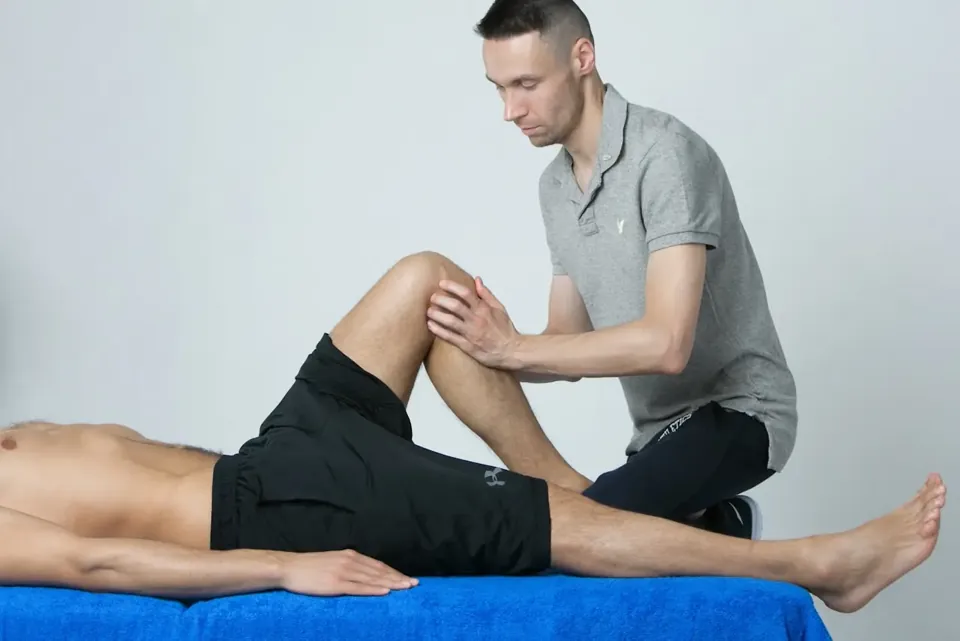
Tendon injuries we treat
Tendon pain (tendinopathy, often called tendonitis) usually develops gradually from overuse:
- Achilles tendon pain at the back of the heel
- patellar tendon pain below the kneecap (jumper's knee)
- rotator cuff tendon pain in the shoulder
- tennis elbow and golfer's elbow
- gluteal tendon pain at the side of the hip
Ligament injuries we treat
Ligament sprains usually happen suddenly, with a twist or a fall:
- ankle sprains, the most common of all
- knee ligament sprains, including the MCL and ACL
- wrist and thumb sprains
How physiotherapy treats tendon pain
Tendons get stronger when they are loaded progressively. A typical program moves through stages:
- holding exercises (isometrics), which often reduce pain
- slow, heavy strengthening through the full movement
- faster and more springy exercises, if your sport or job needs them
- a gradual return to running, jumping or lifting
Changes in how much and how often you train are part of the plan from the start.
How physiotherapy treats ligament sprains
- early care to control swelling and keep the joint moving safely
- strengthening for the muscles that support the joint
- balance and control training, which is essential after ankle and knee sprains to prevent re-injury
- sport- or work-specific drills before you return fully
Your first visit for a tendon or ligament injury
Your physiotherapist asks how the problem started, examines the injured area and tests its strength and stability against the other side. They explain the diagnosis, give you an idea of timelines and start you on the first stage of exercises. If a sprain looks severe enough to need imaging or a medical opinion, they will say so.
When to see a doctor first about a tendon or ligament injury
Go to an emergency department or urgent care if you felt a pop followed by rapid swelling, cannot put weight on the leg, cannot lift the arm, or the joint looks deformed or feels unstable.
Related care for a tendon or ligament injury
Hands-on treatment supports the exercise program: massage for repetitive strain injuries eases overworked muscles, and acupuncture is an option for stubborn tendon pain. For injuries from sport, see sports injury physiotherapy and chiropractic treatment for sports injuries. After a ligament reconstruction, see post-surgery rehabilitation.
Common questions about physiotherapy for tendon and ligament injuries
How long does tendon pain take to heal?
Tendons adapt slowly. Expect steady improvement over six to twelve weeks of consistent strengthening, and longer for problems that have been present for many months.
Should I rest a sore tendon?
Complete rest usually makes a tendon weaker. Reducing the aggravating activity while doing specific strengthening works better.
When can I return to sport after an ankle sprain?
When you have full movement, strength close to the other side and good balance on the injured leg. For a mild sprain that can be two to three weeks, and for a more serious one, several months.
Reviewed by the WellCare Medical clinical team, October 2026.
More from Physiotherapy in Bradford
- Physiotherapy in Bradford
- Physiotherapy for Chronic Pain in Bradford
- Physiotherapy for Joint Stiffness & Muscle Tightness in Bradford
- Physiotherapy for Mobility & Balance Issues in Bradford
- Physiotherapy for Postural Problems & Muscle Imbalances in Bradford
- Physiotherapy for Work-Related Injuries in Bradford
- Post-Surgery Rehabilitation in Bradford
- Sports Injury Treatment in Bradford
- Stroke & Neurological Physiotherapy in Bradford